







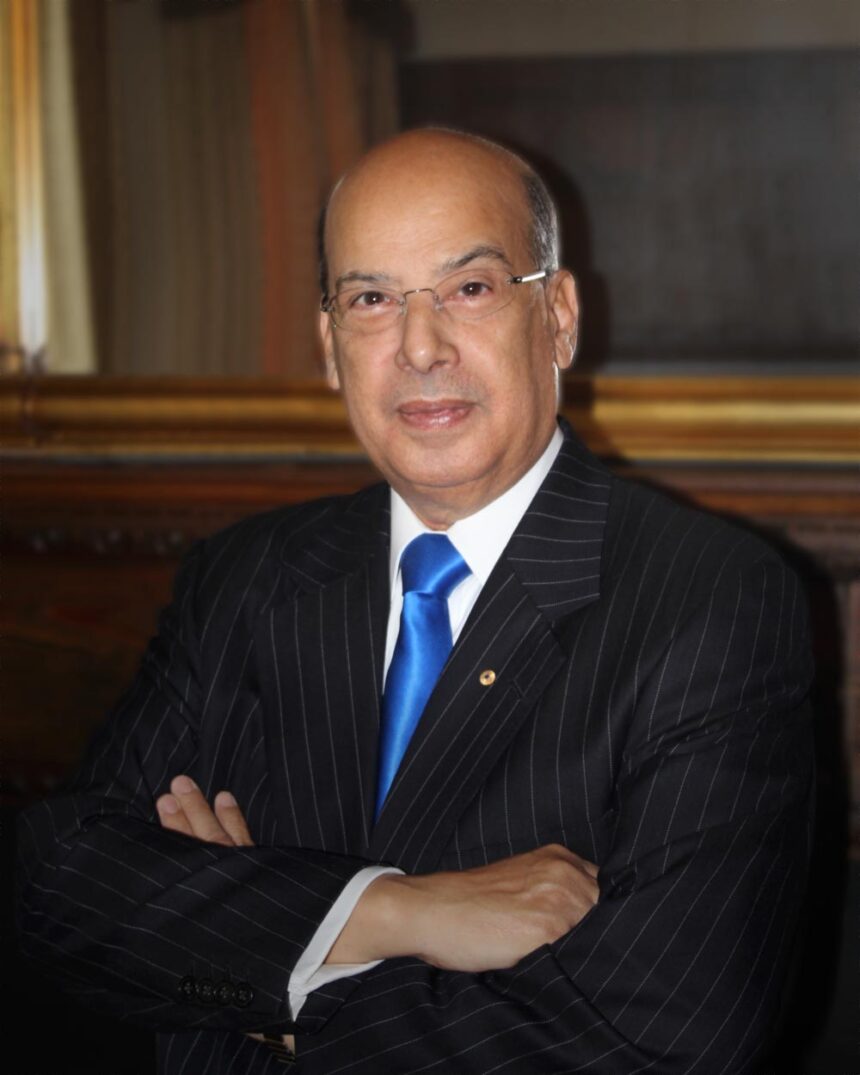
By Sir Ronald Sanders
The United Nations is being starved quietly. This month in New York, the Secretary-General, António Guterres, warned the General Assembly’s budget committee that the UN is entering a “race to bankruptcy.”
The organisation ended 2024 with about US$760 million in unpaid contributions from Member States—most of it still outstanding. A further US$877 million due for 2025 had not yet been received. In all, Member States now owe the UN regular budget roughly US$1.6 billion in arrears. Any institution asked to safeguard global peace, development, human rights, public health, and humanitarian relief would buckle under far less.
Faced with this shortfall, the Secretary-General had no choice but to propose painful cuts for 2026: a 15 per cent reduction—more than US$577 million—and the elimination of 2,681 posts, almost one in five. Some of the steepest reductions fall on Special Political Missions, the very operations that help hold fragile peace processes together.
Yet even these cuts will not repair the cash crisis, because while inefficiencies exist in every institution, the central cause is neither waste nor mismanagement. It is insufficient and unpredictable financing—a condition that the Organization of American States (OAS) knows all too well. For more than fifteen years, the OAS has also struggled with inadequate funding. Next year, its regular budget will be significantly lower in real terms than in 2010, even though mandates have multiplied.
Both organisations—global and hemispheric—are caught in the same bind: overreliance on a handful of countries to pay the lion’s share and delayed or withheld payments from key contributors.
Who is not paying—and why it matters
The UN’s regular budget is apportioned according to national income. The United States is assessed at 22 per cent, the largest share. China is second at close to 20 per cent. When either of them pays late, the UN’s financial circumstances immediately deteriorates.
In the United States, debates over federal spending—especially foreign expenditures—have led to repeated delays. The current administration has added another dimension: postponing payments while it reviews certain aspects of UN operations. China continues to meet its obligations but has in recent years tended to pay much later in the year, leaving the UN short of cash. Other Member States, including several middle-income countries, are also paying behind schedule.
But the impact is greatest when the largest contributors are late. A predictable budget cannot survive unpredictable cashflow.
Small states: exposed and at risk
For the Caribbean and Latin America—regions of small, open economies and climate-exposed societies—the consequences are immediate and severe.
UN development and humanitarian programmes are already shrinking. Development financing—long the backbone of support for least developed and small island states—is eroding at the very moment climate impacts are accelerating.
For Small Island Developing States (SIDS), this is a survival issue. Every dollar removed from UN development and climate-adaptation programmes widens the gap between the threats faced and the ability to respond. As the impacts of climate change worsen, the loss of UN support will carry real human costs.
Peacekeeping at a crossroads
The picture in peace and security is equally troubling. Peacekeeping is often the last buffer before catastrophe. When budgets shrink and reimbursements slow, missions are forced to operate with fewer resources, weaker mandates, and diminished capacity to protect civilians.
Some major capitals are now considering reducing or restructuring their contributions to peacekeeping. Such debates are understandable; taxpayers everywhere want accountability for money spent abroad. But if the UN retreats, the world will rely more heavily on ad hoc coalitions or regional deployments, often with fewer safeguards, less transparency, and less legitimacy.
As with the OAS, when resources dwindle, only the activities preferred by the richest countries survive. That is not a recipe for balanced multilateralism.
A narrowing United Nations
As budgets tighten, the UN is being reshaped—often unintentionally—into a narrower institution. It will still debate, negotiate, and set norms, but without adequate financing, its capacity for field operations, development support, and humanitarian action will decline.
That is not the UN that the world needs. In disaster recovery, health crises, climate resilience, arms control, and the defence of small-state sovereignty, we rely on the UN to deliver support.
If insolvency forces the UN into retreat, the weakest and smallest states will be the first to feel the vacuum. And vacuums rarely remain empty; they are filled by the interests of the powerful.
What Must Change
The way forward requires only practical steps that Member States have already contemplated.
The UN’s financial instability is fundamentally a problem of timing. Contributions that arrive late, especially from the largest economies, create liquidity shocks that no amount of internal belt-tightening can absorb. The organisation would be strengthened considerably if all Member States, large and small, regarded timely payment of assessed contributions as integral to the mandates they approve. Such predictability is essential not only at the UN but also within the OAS.
There is also an outstanding proposal before the General Assembly to suspend the automatic return of unspent budget credits when liquidity falls below a safe threshold. This is financially prudent. It makes little sense for the UN to refund credits while simultaneously cutting staff and scaling back programmes due to lack of cash. A modest buffer could prevent unnecessary disruption. The OAS faces a similar anomaly: states receive a bonus for paying dues on time, while others incur no penalty for paying late or not at all.
The UN is now needed more than ever
Small countries need the UN most. It is in their interest to lead by example—paying contributions on time, honouring obligations, and encouraging the richest nations to do the same. The alternative is a weakened, less effective international system and a drift toward a world governed less by law and more by power.
The UN is already in a race to bankruptcy. Should it stumble, the world will learn quickly that when multilateralism weakens, the strong grow stronger—and the small stand alone.
(The author is the Ambassador of Antigua and Barbuda to the United States and the OAS, and Dean of the OAS Ambassadors accredited to the OAS. Responses and previous commentaries: www.sirronaldsanders.com)